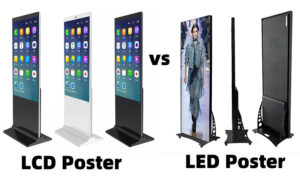
What is an LCD screen?
LCD, also known as a liquid crystal display, is a technology that uses the optical properties of liquid crystal molecules to display images. It is also a non-self-emissive display. Electronic device display equipment
Core Display Principles
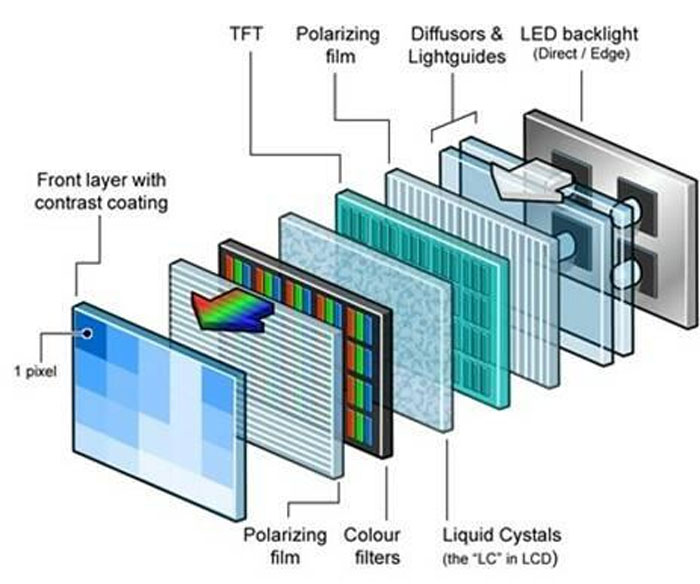
LCDs themselves do not emit light and rely on a backlight for illumination. When light passes through the liquid crystal layer, the deflection angle of the liquid crystal molecules is controlled by an electric field to adjust the light transmittance. After being filtered by polarizers and color filters, the light is finally displayed on the screen as an image with different brightness and color.
Core Structure
- Backlight layer: Responsible for providing a uniform light source.
- Liquid crystal layer: Located between two glass substrates, it contains liquid crystal material and controls the amount of light passing through by changing the voltage.
- Polarizer and filter: Located on both sides of the liquid crystal layer, they are responsible for filtering light from specific directions to achieve color separation.
- Driving circuit: Receives signals and controls the deflection of liquid crystal molecules.
What is an LED display screen?
LED displays are flat-panel display devices that use light-emitting diodes (LEDs) as pixels. They display images, text, and videos by directly emitting light through controlling the on/off state, brightness, and color of each LED. They are widely used in commercial advertising, stage concerts, transportation hubs, command centers, government and enterprise conference rooms, and sports venues.
Core Display Principles
It is a semiconductor device that converts electrical energy into light energy. The display screen uses a combination of red (R), green (G), and blue (B) LED beads, and the control circuit adjusts the on/off state and brightness ratio of each bead to achieve full-color image display.
Core Components
- Display Module: The smallest display unit of the screen, integrating LED beads, driver IC, and PCB circuit board.
- Control system: The "brain" of the display screen, including the receiving card and the sending card.
- Power supply system: Provides stable low-voltage DC power to ensure the continuous operation of the equipment.
- Structural frame: aluminum profiles, steel frame
LCD Display vs. LED Display: Different Light Emitting Principles
| vs |
LCD |
LED |
|
Light emission mode |
Dependent on the backlight |
Self-illuminating |
| Display principle | Liquid crystal materials are used to control light, and backlights provide the light source. | LED chips direct electroluminescence imaging |
| Core Structure | Backlight layer + liquid crystal layer + color filter | Composed of only LED chip lamp beads, a pixel array |
LCD vs. LED Displays: Performance Differences
|
vs |
LCD |
LED |
|
Contrast |
The contrast is mediocre, and backlighting is frequent. |
Very tall, pure black. |
|
seams |
Bordered seams |
Seamless splicing |
| Viewing angle | When viewed from the side, the colors shift, and the brightness gradually decreases. |
The color and brightness remain almost unchanged from any angle. |
|
Response speed |
Response time is mostly 5-10ms |
Response time < 1ms |
|
size |
Limited Spelling |
Unlimited spelling |
|
thickness |
It's relatively thick and requires a backlight module. |
Thinner, without a backlight layer |
|
life |
Approximately 50,000 to 80,000 hours |
Approximately 100,000 hours |
LCD vs. LED Displays: Different Typical Application Scenarios
|
vs |
LCD |
LED |
|
Application scenarios |
|
|
|
Scene characteristics |
Suitable for use with static images for extended periods of time |
Pursuing ultimate image quality, large-size splicing, and display of images and dynamic videos. |
|
occasion |
Indoor use occasions |
High-brightness, large-size splicing applications |
|
cost |
Relatively low |
Relatively high |
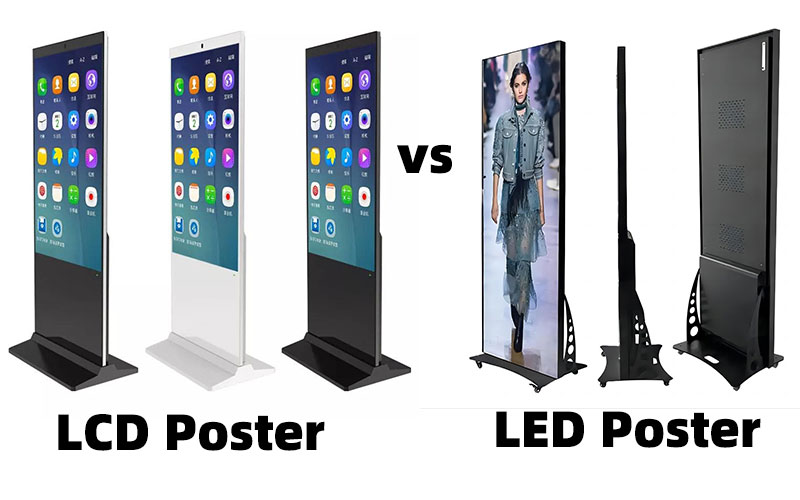
LCD Poster Display vs. LED Poster Display: Comparison of Specific Product Projects
| vs | LCD Poster Screen | LED poster screen |
| brightness | 300-700nits | 300-700nits |
| Technical Principles | LCD + LED backlight, passive light emission | LED self-illuminating |
| Suitable usage distance | close up | Mid-to-long distance |
| Viewing angle | Around 170°, but the image will have color distortion and reduced brightness when viewed from the side. | 178° full viewing angle, with almost no change in color brightness from any angle. |
| maintain | Backlights are prone to aging and may develop light leakage or dead pixels. | Modular design, individual LEDs can be replaced. |
| price | $300-$1200 | $740-$3000+ |
| thickness | 3-5cm, including backlight module | 2-3cm, no backlight layer required |
How should one choose between LCD and LED displays?
| Price factors | LCD | LED | What are your priorities? |
| price | Relatively low | Relatively high | Limited budget → LCD |
| Close-up image quality | High (4K mature) | Medium (small pitch is expensive) | Close-up view → LCD |
| Long-distance brightness | Low | high | Long-distance viewing → LED |
| Contrast | Relatively low | High (Pure Black) | Watching movies in a dark theater → LED |
| size | Suitable for limited sizes | Suitable for large sizes | Large size → LED |
| Energy consumption | Backlighting needs to be constantly on, resulting in high energy consumption. | Low energy consumption | 24-hour operation → LED |
| thickness | Thicker | thinner | Mobile → LED |
| static | It can be achieved | It can be achieved | More static images → LCD |
| dynamic | It cannot be achieved. | It can be achieved | More dynamic images → LCD |
LCD and LED Display Trends and Future Outlook
LCD vs LED: Industry Trends
| Industry Trends | LCD | LED |
| Market positioning | Low-to-mid-end consumption | High-end consumption |
| Application scenarios | High cost-performance scenarios | Emerging creative ideas, large-scale commercial scenarios |
| technology | The technology is relatively mature. | MiniLED technology is constantly being upgraded. |
| Profit margin | Relatively roll | Relatively high |
| growth rate | Relatively stable | High growth |
| AI integration | Low | high |
Trend forecast for the next 5 years
- LCD: It won't disappear, but it will gradually shift from general-purpose to specialized types. It's relatively stable and also more prone to rolling, so market growth won't be significant.
- LED: Continued growth in the mid-range market will lead to a surge in many emerging application scenarios, offering high profits and greater future opportunities.
- Long-term: MicroLED will gradually become the next-generation mainstream self-emissive display technology, but LCD and LED will still exist in their respective scenarios. With multiple technologies running in parallel, it is currently one of the most valuable sub-sectors for investment.
Frequently Asked Questions
Q1: Can LCD screens be used outdoors?
Not recommended because LCDs are not suitable for: 1. Insufficient screen brightness; 2. Insufficient anti-glare capability; 3. Insufficient waterproof capability; 4. Inability to achieve seamless splicing; 5. Poor environmental adaptability.
However, LED displays are better suited for outdoor use because: 1. they are brighter; 2. they have an IP65 waterproof rating; and 3. they are suitable for harsh outdoor environments.
Q2: Which is better for your eyes when looking at an LCD screen or an LED screen for a long time?
Because LED screens are brighter, they are less likely to cause eye strain in bright light environments; moreover, in dark environments, the pure black of LEDs is more eye-friendly than the light leakage of LCDs.
Q3: What are the differences in maintenance between LCD and LED?
If an LCD panel is damaged, the entire panel usually needs to be replaced; however, if a single LED chip in an LED screen is damaged, the entire module can be repaired, resulting in lower long-term maintenance costs and greater flexibility.
Q4: Is the light leakage problem only present in LCD screens?
Yes, LCDs rely on a backlight module, and backlight located at the edge or corner of the screen can easily leak through gaps, causing light leakage; LEDs do not have this problem because LED chips emit light independently and do not require a backlight layer.
Q5: When displaying a large area, is the flatness of LED better than that of LCD?
Yes, LCD screens are limited by the physical properties of glass; when made large, they are prone to micro-deformation due to thermal expansion and contraction and gravity. LED screens, on the other hand, are composed of modules spliced onto a precision-machined die-cast aluminum housing, ensuring micron-level flatness, making them ideal for manufacturing large-sized flat screens and even curved screens.
Q6: Why does an LCD screen appear grayish when displaying black?
The backlight layer of an LCD is globally diffused. Even when displaying black, the liquid crystal can only block most of the light, not 100% of it, so light will leak out, and black will appear grayish.
in conclusion
This blog post primarily discusses the differences between LCD and LED displays. Do you know how to choose the right screen type?
Still have questions or need guidance? Contact us anytime! Welcome to ViroLED – a professional LED display manufacturer in Shenzhen with 15 years of experience, serving customers in over 30 countries and regions worldwide. We provide one-stop LED display solutions from design and production to installation for government, enterprise, commercial, cultural tourism, and overseas engineering companies. We support full-size and full-scenario customization, and can provide tailored advice to help you create the most suitable display solution!